
On this page
Medical coding is the process of converting the diagnoses, procedures, services, drugs, and supplies documented in a patient's medical record into standardized codes. ICD-10-CM codes describe why the patient was seen. CPT and HCPCS Level II codes describe what the provider did or supplied. Health plans read these codes on medical claims to decide coverage and payment, so every code must match the documentation and the payer's rules.
For a physician practice, coding is the step where clinical work becomes a billable claim. A visit can be well documented and medically appropriate and still be denied or underpaid if the codes do not match the record, the payer's rules, or the code set in effect on the date of service. This guide covers medical coding basics: how coding works, the main code sets, how billing and coding differ, a worked example, and how to measure coding accuracy.
What Is Medical Coding?
Medical coding is the assignment of standardized codes to the clinical information in a medical record. Under HIPAA administrative simplification standards, HHS has adopted specific code sets for electronic health care transactions. ICD-10-CM is used for diagnosis coding in all settings, and ICD-10-PCS is used for inpatient hospital procedures. HCPCS covers other procedures, services, and supplies, and it has two levels: Level I is CPT, maintained by the AMA, and Level II is maintained by CMS.
CMS explains these standards in its Health Care Code Sets fact sheet and code sets overview. NCHS maintains ICD-10-CM, and CMS maintains ICD-10-PCS and HCPCS Level II.
Coding is not transcription. A coder applies official guidelines and reports only the codes the documentation supports, even when the coder believes another code describes what happened. That principle is the foundation of coding compliance, and it connects every step of the claim:
Clinical documentation → diagnoses and procedures → code selection → claim → payer adjudication → payment or denial
A weakness at any link affects everything after it. Many claim problems that look like billing issues start earlier in this chain.
Medical Coding Basics: What, Why, and Under What Circumstances
A simple way to understand a coded claim is to ask three questions. This is a simplified educational framework, not a complete description of every coding scenario.
What happened? (CPT and HCPCS)
CPT and HCPCS Level II codes describe the service, procedure, drug, or supply. An office visit, a joint injection, and the injected drug each get their own code.
Why did it happen? (ICD-10-CM)
ICD-10-CM codes describe the diagnosis, symptom, or reason for the encounter. They explain why the service was medically necessary.
Under what circumstances? (Modifiers, units, and rules)
Modifiers, units of service, place of service, the documentation, payer rules, and applicable coding guidance describe the conditions of the service. They can determine whether two services are paid separately, how much drug is billed, or whether a claim passes payer edits.
Why Is Medical Coding Important?
Medical coding is important because codes are the language payers use to make payment decisions. Accurate codes support correct reimbursement, fewer avoidable denials, and defensible records during audits. Inaccurate codes can cause underpayment, overpayments that must be returned, compliance exposure, and slower cash flow.
-
Reimbursement. Fee schedules, including the Medicare Physician Fee Schedule, pay by procedure code, and some modifiers and units affect the amount.
-
Medical necessity. Diagnosis codes explain why a service was provided. Payers compare them with coverage rules such as Medicare National and Local Coverage Determinations (NCDs and LCDs).
-
Compliance. A code the record does not support can create an overpayment, and Medicare overpayments that a provider identifies must be reported and returned.
-
Data quality. Diagnosis codes feed risk adjustment and quality measures, so under-coding chronic conditions understates how complex a patient panel is.
How Does Medical Coding Work?
Medical coding works as a sequence: review the documentation, identify reportable diagnoses and services, select codes from the correct code set and code year, confirm specificity, add supported modifiers, check edits and payer policies, and pass the coded encounter to billing. The steps below describe physician and outpatient coding; hospital inpatient coding adds ICD-10-PCS and different guideline sections.
1. Review the Clinical Documentation
The coder reads the provider's note for the date of service: history, examination, assessment and plan, orders, procedure notes, and any statement of time. The coder also confirms the note is signed and identifies the rendering provider.
Example: A note reads "Follow-up for type 2 diabetes and hypertension. A1c reviewed. Metformin dose increased. BP at goal." Two chronic conditions were addressed, a result was reviewed, and a prescription drug decision was made. Each fact affects the diagnosis codes and the evaluation and management (E/M) level.
2. Identify Diagnoses and Procedures
Diagnoses, symptoms, and reasons for the visit become ICD-10-CM codes. Services, procedures, drugs, and supplies become CPT or HCPCS Level II codes.
Setting changes the rules. For outpatient and physician services, the FY 2027 ICD-10-CM Official Guidelines for Coding and Reporting instruct coders not to code diagnoses documented as "probable," "suspected," or "rule out." The coder reports the signs and symptoms instead. Inpatient coding handles uncertain diagnoses differently.
Example: An office note documents "cough and fever, rule out pneumonia; chest X-ray ordered." The coder reports cough and fever, not pneumonia.
3. Select the Appropriate Code
For ICD-10-CM, coders locate the term in the Alphabetic Index and confirm the code in the Tabular List, where notes such as "Excludes1" and "use additional code" apply. For CPT, coders read the full descriptor and the guidelines for that code family.
The code year must match the date of service. According to CMS's ICD-10 page, the FY 2027 ICD-10-CM files apply to encounters and discharges from October 1, 2026 through September 30, 2027. A visit on September 30, 2026 uses the FY 2026 code set.
4. Verify Specificity and Documentation
ICD-10-CM codes contain three to seven characters. Many three-character categories are subdivided, and when a code has additional characters available, including a required seventh character, the coder reports the complete code at the level of detail the code set requires. A category that has subdivisions is not reported on its own. Within that structure, coders choose the most specific code the documentation supports, not the most specific code that exists.
Example: "Primary osteoarthritis, right knee" supports M17.11. If the note says only "knee osteoarthritis," the coder cannot assume the side. The right step is a compliant provider query, not a guess.
5. Apply Modifiers When Appropriate
Modifiers are two-character codes appended to a CPT or HCPCS code to communicate a circumstance that affects how the service is reported or interpreted. A modifier does not change the code's definition, not every modifier affects payment, and each modifier applies only in specific situations:
-
Modifier 25. An E/M service may qualify for modifier 25 when the documentation supports a significant, separately identifiable E/M service beyond the work inherent in the procedure.
-
Modifier 59 and the X{EPSU} modifiers. These may apply when documentation supports a distinct procedural service, such as a separate encounter (XE), separate structure (XS), different practitioner (XP), or unusual non-overlapping service (XU), and the applicable edit allows a modifier.
-
Modifiers 26 and TC. For services with professional and technical components, such as many imaging studies, 26 may apply when the provider performs only the interpretation, and TC when the practice provides only the equipment, staff, and supplies.
-
RT and LT. These identify the right or left side when laterality affects how a service is reported or edited.
Example: A patient arrives for a scheduled knee injection and reports new shortness of breath. The physician takes a separate history, examines the patient, and orders a chest X-ray. If the note documents that separate evaluation, the E/M visit may qualify for modifier 25. If the note shows only the routine pre-injection assessment, it does not. Appending modifier 25 by habit is a recognized audit risk.
6. Check Applicable Coding Edits and Guidelines
Codes should pass the edits the payer will apply. For Medicare, the main edits come from the National Correct Coding Initiative (NCCI):
-
Procedure-to-procedure (PTP) edits identify code pairs that should not normally be reported together for the same patient on the same date. Each pair carries a modifier indicator. Some pairs never allow a modifier to bypass the edit. Others allow one only when the clinical circumstances meet the applicable guidance and the documentation supports a distinct service.
-
Medically Unlikely Edits (MUEs) set the maximum units of service a provider would report for a code for one patient on one date under most circumstances. Depending on the code, an MUE may be applied per claim line or per date of service.
Coders also check coverage policies. Medicare NCDs and LCDs are published in the Medicare Coverage Database. Medicaid programs and commercial payers may apply their own edits and policies, which can differ from Medicare's.
7. Complete the Coding Workflow
The coded encounter moves to charge entry and claim creation. A complete workflow also sends provider queries, logs unresolved questions, and flags recurring documentation gaps for education, so the same error does not repeat on the next hundred claims.
Medical Coding Example: From Patient Visit to Claim
The example below is hypothetical and simplified. It follows one established-patient office visit from the exam room to payment.
-
Clinical encounter. An established patient visits a family medicine office for follow-up of type 2 diabetes and hypertension.
-
Provider documentation. The physician documents both conditions, reviews a recent A1c result, increases the metformin dose, and notes that blood pressure is at goal on the current medication.
-
Diagnosis identification. The documented conditions are type 2 diabetes without complications (E11.9) and essential hypertension (I10). If the physician had documented the diabetes as poorly controlled or with hyperglycemia, E11.65 would apply instead. The coder does not infer that from the A1c value alone.
-
Procedure or service identification. The service is an established-patient office visit. No separate procedure was performed.
-
Code selection. Two chronic conditions and prescription drug management can support moderate medical decision making, which corresponds to CPT 99214 when the note documents those elements.
-
Modifier, unit, and edit review. No modifier applies, the visit is one unit, and both diagnoses are linked to the visit line.
-
Claim creation. Billing builds the professional claim with the codes, place of service, rendering provider, and patient insurance details.
-
Payer adjudication. The payer checks eligibility, code validity for the date of service, edits, and coverage rules.
-
Payment or denial. The payer pays the allowed amount minus the patient's cost share, or denies the claim with reason codes that show which step failed.
If the documentation had not supported moderate decision making, the correct code would be lower. Reporting 99214 anyway would create an overpayment risk.
What Are the Main Medical Code Sets?
The main U.S. medical code sets are ICD-10-CM for diagnoses, ICD-10-PCS for inpatient hospital procedures, CPT for professional and outpatient services, and HCPCS Level II for supplies, drugs, equipment, and services not in CPT. HIPAA standards also include CDT for dental services and NDC for drugs in retail pharmacy transactions.
|
Code set |
Maintained by |
What it describes |
Where it is used |
Format |
Update cycle |
|
ICD-10-CM |
NCHS (CDC) |
Diagnoses, symptoms, injuries, and reasons for encounters |
All U.S. health care settings |
3 to 7 characters; first is a letter |
Annually on October 1; mid-year updates possible |
|
ICD-10-PCS |
CMS |
Procedures performed on hospital inpatients |
Hospital inpatient facility claims |
7 alphanumeric characters |
Annually on October 1; mid-year updates possible |
|
CPT (HCPCS Level I) |
AMA |
Services by physicians and other qualified health care professionals |
Professional, hospital outpatient, and ambulatory surgery claims |
Category I codes are 5 digits |
Annually, generally effective January 1 |
|
HCPCS Level II |
CMS |
Supplies, equipment, drugs, ambulance, and services not in CPT |
Professional, outpatient, and DMEPOS claims |
1 letter followed by 4 digits |
Quarterly update files |
A physician practice uses ICD-10-CM, CPT, and HCPCS Level II daily. ICD-10-PCS rarely appears on professional claims, although the hospital codes inpatient stays from the same physician documentation.
What Are CPT Codes?
CPT (Current Procedural Terminology) codes describe the medical, surgical, and diagnostic services a provider performs, such as an office visit or an electrocardiogram. The AMA maintains CPT through its CPT Editorial Panel, and CMS recognizes CPT as Level I of HCPCS. On a claim, the CPT code tells the payer what was done; the diagnosis code tells the payer why.
-
Category I codes are five digits and describe services in widespread use, organized into sections such as Evaluation and Management, Surgery, Radiology, Pathology and Laboratory, and Medicine.
-
Category II codes are four digits followed by F. They track performance measures and are generally not paid.
-
Category III codes are four digits followed by T and describe emerging technologies.
E/M codes appear on most physician claims. Since 2021, office visit levels (99202 to 99215) are selected by medical decision making (MDM) or by the practitioner's total time on the date of the encounter. Time-based coding requires a documented total time; MDM-based coding requires documentation of the problems, data, and risk at the level billed. CPT changes are published annually and generally take effect January 1.
What Are ICD-10-CM Diagnosis Codes?
ICD-10-CM diagnosis codes report diseases, injuries, symptoms, and other reasons for encounters in all U.S. settings. The CDC's National Center for Health Statistics maintains the code set. Codes contain three to seven characters, begin with a letter, and must be reported at the full level of detail the code requires and the documentation supports.
The first three characters identify the category. Characters four through six add etiology, site, severity, or laterality. A seventh character, where required, adds information such as the episode of care, and the placeholder "X" fills empty positions before it.
Example: S52.521A reports a torus fracture of the lower end of the right radius, initial encounter for closed fracture. Follow-up visits during routine healing use the seventh character "D."
The FY 2027 code set applies to encounters and discharges from October 1, 2026 through September 30, 2027. The FY 2027 Official Guidelines for Coding and Reporting accompany it. They are developed by the Cooperating Parties (AHA, AHIMA, CMS, and NCHS) and supplement the conventions and instructions in the code set itself. The HIPAA standard adopts ICD-10-CM together with these Official Guidelines, so they are the baseline rules for diagnosis code assignment; payers may add their own reporting requirements on top. Practices should review each year's changes for their common diagnoses and update EHR favorites and superbills that still list deleted or expanded codes.
What Is HCPCS Level II?
HCPCS Level II is the CMS-maintained code set for items and services CPT does not include. CMS describes it as used "primarily to identify products, supplies, and services not included in the CPT codes, such as ambulance services or durable medical equipment, prosthetics, orthotics, and supplies (DMEPOS) when used outside a physician's office." Each code is one letter followed by four digits.
Physician practices use Level II mostly for injectable drugs (J codes), certain Medicare-specific services (G codes), and supplies. CMS posts updates as quarterly files on its HCPCS quarterly update page, and its HCPCS overview explains both levels.
Example: A physician injects 80 mg of methylprednisolone acetate into a patient's knee in the office. The claim reports CPT 20610 for the major joint injection without ultrasound guidance and HCPCS J1010 (injection, methylprednisolone acetate, 1 mg) for the drug. Because J1010 is defined per 1 mg, the drug line is billed as 80 units. J1010 replaced the former 20 mg, 40 mg, and 80 mg codes in April 2024, so a superbill that still lists J1030 or J1040 is out of date. Many payers also require the drug's NDC on the claim.
For Medicare Part B drugs furnished from a single-dose container, CMS requires the JW modifier on the line reporting a discarded amount (with the discarded amount documented) or the JZ modifier when nothing was discarded, as explained in the CMS JW and JZ modifier FAQs. These modifiers do not apply to drugs drawn from multiple-dose vials, so the coder needs to know which container was used.
What Is the Difference Between Medical Billing and Coding?
Medical coding translates clinical documentation into codes. Medical billing uses those codes to submit the claim, follow it through payer adjudication, post payments, work denials, and bill the patient's balance. Coding answers what was done and why; billing answers who pays, how much, and when.
|
Area |
Medical coding |
Medical billing |
|
Main input |
Clinical documentation |
Coded encounter, demographics, insurance information |
|
Main output |
ICD-10-CM, CPT, and HCPCS codes with modifiers |
Claims (CMS-1500 or 837P), payment posting, patient statements |
|
Core knowledge |
Official guidelines, code-set conventions, NCCI edits |
Payer rules, eligibility, timely filing, appeals |
|
Typical errors |
Wrong code, unsupported specificity, modifier errors |
Eligibility errors, demographic errors, missed deadlines |
|
Typical metrics |
Coding accuracy, query rate, coding turnaround |
Clean claim rate, denial rate, days in A/R |
In small practices one person often does both, but the checks remain separate: a claim can pass every billing edit and still carry a code the documentation does not support. Front-end steps such as eligibility verification and prior authorization prevent a different set of denials that coding alone cannot fix.
How Does Medical Coding Affect the Revenue Cycle?
Medical coding sits between the visit and the claim, so it shapes every downstream revenue cycle result. Correct codes produce clean claims that payers can adjudicate on first submission. Coding errors produce rejections, denials, or underpayments, and each adds rework and keeps money in accounts receivable longer.
The relationship runs in one direction: coding → claim quality → payer processing → reimbursement → denials → accounts receivable.
-
Claim quality. A clean claim has valid codes for the date of service, correct diagnosis pointers, modifiers, and units, and no edit conflicts.
-
Payer processing. Payer systems apply bundling edits, coverage policies, and code validity checks automatically, without a person reading the chart.
-
Reimbursement. The code, any payment-affecting modifiers, and units determine the allowed amount. An E/M level coded below what the documentation supports is paid, but at less than the work performed.
-
Denials and A/R. Bundling conflicts, modifier errors, and diagnoses that do not meet a coverage policy lead to denials, and every correction or appeal extends the time to payment.
Example: A practice orders a test for a Medicare patient, and the diagnosis on the claim is not one the applicable LCD lists as supporting medical necessity. The claim is denied. If a required Advance Beneficiary Notice of Noncoverage (ABN) was not obtained before the service, the practice generally cannot bill the patient either.
For this reason coding works best inside a coordinated revenue cycle management process, where denial trends are traced to their source instead of fixed one claim at a time.
What Is Medical Coding Accuracy?
Medical coding accuracy is the share of reviewed coding decisions that match what the documentation and official guidelines support. No single industry-wide accuracy rate applies to every practice. A meaningful medical coding accuracy rate depends on how the sample was chosen, what counted as an error, and whether codes, claims, or encounters were the unit of measure.
A credible medical coding audit defines its method before reporting a number:
-
Unit of measure. Code-level, claim-line, and encounter-level accuracy give different results from the same review.
-
Sample selection. Use a random sample for a baseline and targeted samples for risk areas such as high-level E/M visits, modifier 25, new providers, or codes changed this year.
-
Error classification. Classify findings by diagnosis, procedure, E/M level, modifier, units, missing codes, and unsupported codes, and separate overcoding from undercoding.
-
Independent review. The reviewer should not be the original coder, and the guideline year and payer policies used should be recorded.
-
Corrective action. Findings should lead to provider or coder education and corrected claims where needed.
-
Re-audit. A follow-up review of the same area confirms whether the correction worked.
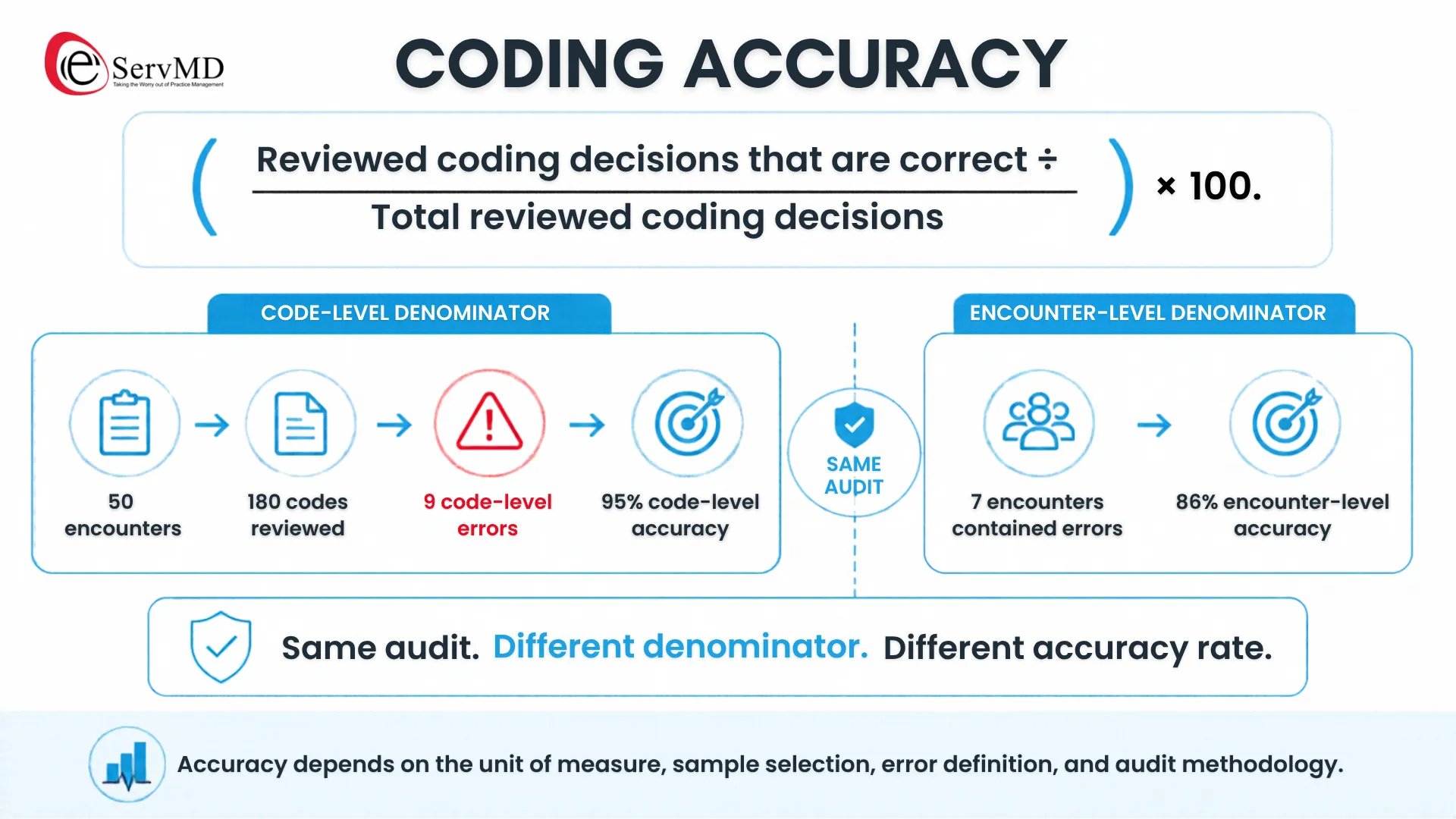
Hypothetical example: An auditor reviews 50 encounters containing 180 codes and finds 9 code-level errors, for 95% code-level accuracy. Those errors fall on 7 encounters, so encounter-level accuracy is 86%. Same audit, two numbers. These figures illustrate the method only and do not represent any organization's performance. When anyone quotes a coding accuracy rate, ask how it was calculated.
A structured compliance and coding audit with a written methodology gives a practice a more reliable picture than an informal spot check.
Common Medical Coding Errors
Most medical coding errors follow a few patterns, and each has a specific control:
-
Incorrect code selection. Codes chosen from memory or an EHR shortcut. Control: confirm against the current code set.
-
Unsupported specificity. Laterality, severity, or complications the note does not document. Control: query the provider.
-
Incomplete documentation. A missing signature, time statement, procedure note, or reason for a test. Control: pre-billing checks for high-risk services.
-
Incorrect modifiers. Modifier 25 or 59 used to bypass an edit without a distinct service documented, or a missing RT/LT where laterality matters. Control: modifier-specific review rules.
-
Diagnosis and procedure mismatch. The diagnosis linked to a line does not explain that service. Control: check pointers on every line.
-
NCCI edit issues. Bundled code pairs reported together, or units above an MUE. Control: current-quarter edit checks before submission.
-
Outdated code knowledge. Deleted or replaced codes, such as J1030, still on superbills after an update. Control: review code-set changes at each update.
-
Documentation and coding inconsistencies. The assessment conflicts with the problem list or orders. Control: resolve the conflict through a query before coding.
-
Medical necessity issues. A correct diagnosis that does not meet the payer's coverage policy. Control: check NCDs, LCDs, and commercial policies, and obtain ABNs when required.
Practices that see these patterns repeatedly often add a pre-submission review step, either in house or through medical coding and chart review support.
What Does a Medical Coder Do?
A medical coder reviews clinical documentation and assigns the ICD-10-CM, CPT, HCPCS Level II, and, in hospitals, ICD-10-PCS codes the record supports. Coders also apply modifiers and units, resolve edit failures and coding denials, send compliant provider queries, and track code-set and payer policy changes.
Outpatient and inpatient coding are different specialties. Physician coders work mainly with CPT, HCPCS Level II, and ICD-10-CM across high volumes of shorter encounters. Inpatient coders use ICD-10-CM and ICD-10-PCS, apply inpatient rules for the principal diagnosis, and code admissions that drive diagnosis-related group (DRG) payment.
What Is a Certified Professional Coder (CPC)?
A Certified Professional Coder (CPC) holds the CPC credential from AAPC, which validates proficiency in physician and outpatient coding with CPT, HCPCS Level II, and ICD-10-CM. Candidates must pass AAPC's exam and maintain the credential through continuing education.
New holders without the required experience carry the CPC-A (apprentice) designation. AHIMA's Certified Coding Specialist (CCS) is oriented toward hospital coding. For a practice, a credential is a baseline: also ask about experience in your specialty and how the coder's work is reviewed.
Medical Coding vs. Medical Billing vs. Coding Auditing
Coding assigns codes, billing turns codes into payment, and auditing checks whether the coding was accurate and compliant.
|
Function |
Primary question |
When it happens |
Output |
|
Medical coding |
What does the documentation support? |
After the encounter, before submission |
Codes, modifiers, units |
|
Medical billing |
Is the claim complete, submitted, and paid correctly? |
Claim creation to final payment |
Claims, posted payments, appeals |
|
Coding auditing |
Was the coding accurate and compliant? |
Before submission (prospective) or after payment (retrospective) |
Findings, accuracy rates, education, corrected claims |
Prospective audits catch errors before payment, avoiding refunds and rebilling. Retrospective audits measure what has already been paid. The HHS Office of Inspector General's General Compliance Program Guidance lists auditing and monitoring as a core element of an effective compliance program.
When Should a Medical Practice Consider Outsourcing Medical Coding?
A practice may consider outsourcing medical coding, fully or in part, when in-house coding cannot keep pace with volume, specialty complexity, or compliance requirements. Common situations include:
-
Coding backlog. Encounters wait days or weeks to be coded, delaying claims and cash.
-
Increased volume. New locations, providers, or patient growth outpace the current team.
-
Specialty complexity. Procedures, injectables, or specialty services bring code families and edits the team has not handled before.
-
Recurring coding-related denials. The same bundling, modifier, or medical necessity denials return because no one has time to trace them.
-
Staff turnover. Vacation, illness, or a departing coder stops claims from going out.
-
New providers or services. New providers also need payer credentialing before their claims will pay, and new services need coding review before launch.
-
Audit findings. A payer audit or internal review identified problems that need correction and monitoring.
-
No internal quality assurance. Providers select codes with no second review, leaving both undercoding and overcoding undetected.
Outsourcing does not remove the practice's responsibility for appropriate oversight and compliance. Claims are still submitted under the practice's providers, so the practice should expect quality assurance, regular reporting, a clear escalation path for coding questions, a business associate agreement (BAA) where HIPAA applies, PHI security controls, verified coder credentials, relevant specialty experience, and documented workflows. If the root cause is documentation habits, a coding team can identify the pattern, but providers still need to change how they document.
What Should a Medical Practice Look for in a Medical Coding Service?
A medical coding service should show how it reaches accurate codes, not only claim that it does. Useful questions for any vendor:
-
Are coders credentialed (for example, CPC or CCS), can we verify those credentials, and do they have experience in our specialty?
-
How do you verify codes against the current code year and quarterly updates?
-
Do you check NCCI PTP edits, MUEs, and payer-specific policies before submission?
-
What is your provider query process, and how are coding questions escalated?
-
How do you measure coding accuracy, and can we see the audit methodology?
-
Will you sign a business associate agreement, and how is protected health information secured?
-
What reporting will we receive on errors, documentation trends, and turnaround?
-
Are your coding workflows documented so our team can review them?
A good coding partner makes every code traceable to the documentation and the guideline behind it.
Frequently Asked Questions About Medical Coding
What is medical coding?
Medical coding is the conversion of documented diagnoses, services, drugs, and supplies into standardized codes used on medical claims. ICD-10-CM codes explain the reason for care, and CPT and HCPCS Level II codes describe what was provided.
What is medical coding in simple terms?
Medical coding turns what happened during a patient visit into standardized codes. A diagnosis code explains why the patient was seen, and a procedure code describes what the provider did. Insurers process claims from these codes.
Why is medical coding important?
Medical coding determines how claims are paid and whether services meet coverage rules. Accurate coding supports correct reimbursement and compliance; errors lead to denials, underpayments, and refunds.
How does medical coding work?
A coder reviews documentation, selects ICD-10-CM, CPT, and HCPCS Level II codes for the correct code year, adds supported modifiers, checks NCCI edits and payer policies, and sends the encounter to billing.
What are the main medical code sets?
The main code sets are ICD-10-CM (diagnoses), ICD-10-PCS (inpatient hospital procedures), CPT (professional and outpatient services, maintained by the AMA), and HCPCS Level II (supplies, drugs, and services not in CPT, maintained by CMS).
What is the difference between medical billing and coding?
Coding assigns codes based on clinical documentation. Billing uses those codes to submit claims, follow up with payers, post payments, manage denials, and bill patients.
What is a CPT code?
A CPT code is a five-character code maintained by the AMA that describes a medical, surgical, or diagnostic service, such as an office visit (99213) or a major joint injection (20610).
What is an ICD-10-CM code?
An ICD-10-CM code is a three- to seven-character diagnosis code for a disease, injury, symptom, or reason for an encounter. NCHS maintains it, and the code set is updated each October 1.