On this page
A payer scorecard arrives showing your practice at 61% on colorectal cancer screening and 54% on diabetes blood sugar control. Someone asks who is responsible for fixing it, and the room goes quiet. The measures belong to a framework called HEDIS, and while health plans calculate it, your documentation, coding, and scheduling decide most of the result.
This guide explains what HEDIS is, how plans build the numbers from your claims and charts, and where the money actually moves. It also separates what the research supports from what depends on your individual payer contracts, because no universal dollar figure exists.
HEDIS in Brief
-
What it is: HEDIS (Healthcare Effectiveness Data and Information Set) is a standardized set of performance measures maintained by NCQA, the National Committee for Quality Assurance.
-
Who reports it: Health plans report HEDIS results. Practices do not file HEDIS reports, but plans build the rates from practice claims, supplemental data, and medical records.
-
How it affects revenue: Through quality incentives and value-based contracts, plan-run gap-closure programs tied to Medicare Advantage Star Ratings, and the preventive and chronic care visits that closing a gap usually requires. The size of the effect depends on your contracts.
-
What a practice controls: Delivering the service, documenting it, coding it correctly, billing it on time, and answering chart requests.
What Is HEDIS, and Who Actually Reports It?
HEDIS is the measurement set health plans use to report how well they deliver care. NCQA publishes the HEDIS measures and technical specifications each year, and NCQA states that more than 227 million people are enrolled in plans that report HEDIS results (confirm the current figure on the NCQA page before publishing). That reach is why payers build contracts around it.
The HEDIS quality measures group into broad domains. These work as quality performance indicators for the plan, and plans pass them down to practices as targets:
-
Prevention and screening, such as colorectal and breast cancer screening and immunizations.
-
Chronic condition management, such as blood pressure control and diabetes care.
-
Behavioral health, such as depression screening with follow-up and substance use treatment engagement.
-
Care coordination and utilization, such as readmissions after a hospital stay.
-
Member experience, collected through the CAHPS survey rather than from claims.
Each clinical measure has a denominator (members who qualify), a numerator (members who received the required care or reached the required result), and exclusions (members who legitimately drop out, such as those in hospice). Most of your leverage comes from the numerator and from documenting valid exclusions.
HEDIS vs. MIPS vs. Star Ratings
These three programs share some clinical topics, so they are easy to confuse. They have different reporters, scorers, and consequences.
|
Program |
Who reports |
Who scores |
Data source |
What it influences |
|---|---|---|---|---|
|
HEDIS |
Health plans, with an NCQA-certified audit |
NCQA specifications; plans and payers apply the results |
Claims, supplemental data, medical record review, electronic clinical data |
Plan quality reporting, payer scorecards, practice incentives under contract |
|
Medicare Advantage Star Ratings |
Plans supply HEDIS, CAHPS, and other data |
CMS rates each contract on a 1- to 5 star scale |
HEDIS, CAHPS, Health Outcomes Survey, plan administrative data |
Plan reputation and plan-level payments, which drives plan outreach to practices |
|
MIPS |
Clinicians and groups report directly to CMS |
CMS |
Quality measures submitted by the practice, plus other categories |
Medicare Part B payment adjustments |
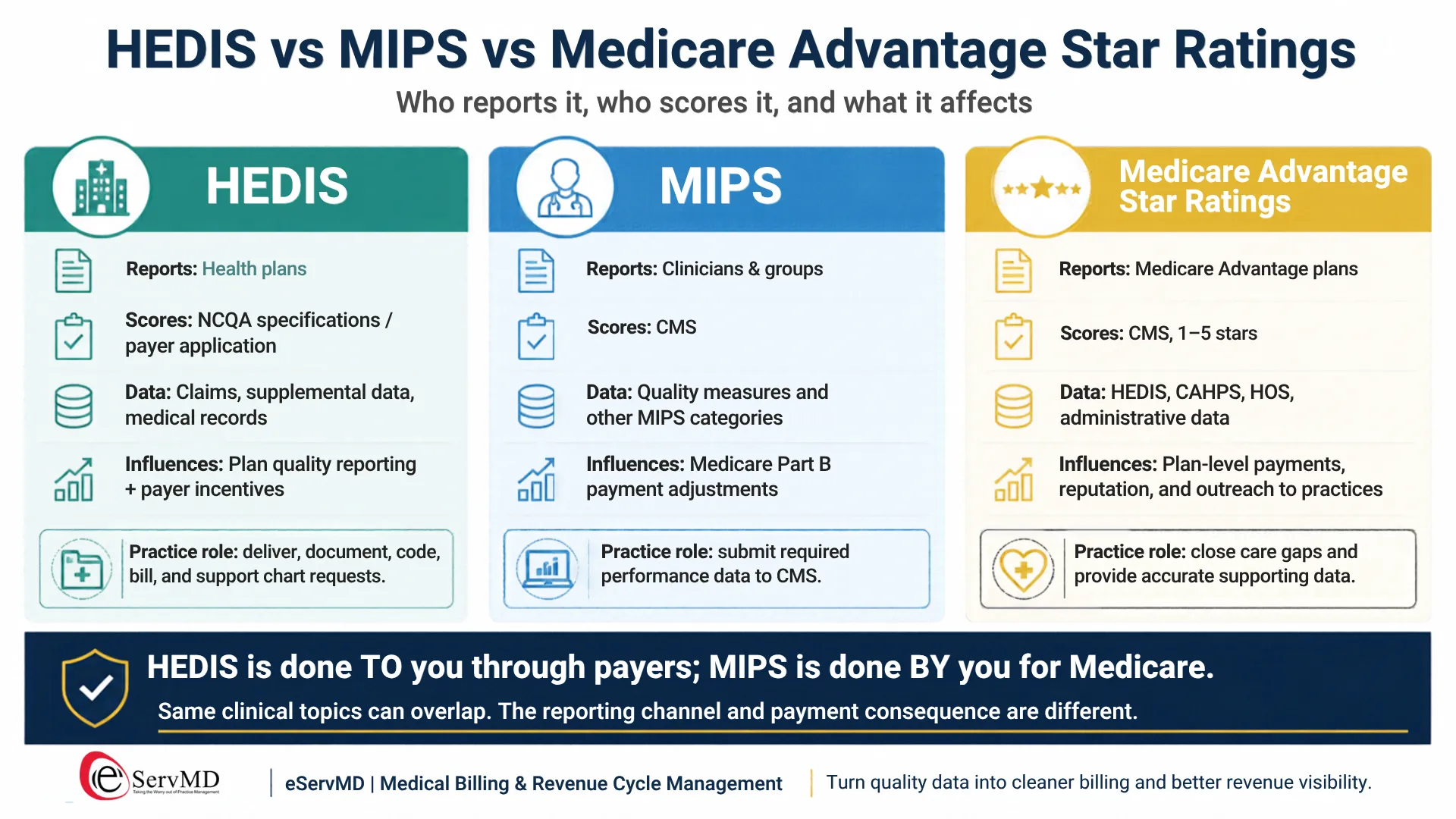
The practical rule: HEDIS is done to you through your payers, while MIPS is done by you for Medicare. A strong MIPS submission does not close a HEDIS gap, and the reverse is also true.
How HEDIS Reporting Works in Medical Billing
HEDIS reporting in medical billing is a data pipeline, and a break anywhere in it means a service you delivered never counts. A typical path looks like this:
-
The patient is seen and the service or result is documented in the chart.
-
The claim goes to the payer with accurate diagnosis, procedure, and quality codes.
-
The plan's HEDIS software reads claims first (the administrative method).
-
For many measures, the plan fills the remaining gaps with supplemental data, such as lab feeds and registries, or by requesting charts from your office (the hybrid method).
-
An auditor verifies the plan's process, and the plan finalizes its rates.
-
The payer sends your practice a scorecard, a gap list, or an incentive calculation.
Plans calculate rates for a measurement year, and results are reported after that year ends. That lag matters: a gap you close in December can still count, but a gap you close the following February generally does not count for that year.
Where the billing team moves the numerator
Four billing-side factors decide whether a delivered service shows up in the rate:
-
Quality codes on the claim. CPT II codes report results such as an HbA1c value or a blood pressure reading. Without them, the plan may have no claims-based proof and must rely on a chart chase. Your medical coding team should know which codes each payer accepts.
-
Diagnosis accuracy. Diagnosis codes place patients in the right denominator and support valid exclusions. A missing diabetes diagnosis can remove a patient from the diabetes measures altogether, which hides a gap, and an incorrect one can add a patient who should not be there.
-
Claim timing and quality. Plans set data cutoffs, so late or rejected claims can miss the run-out window. Tracking your clean claim rate protects both cash flow and quality data.
-
Correct provider attribution. Rates are tied to the provider or group a member is attributed to. Wrong NPIs, taxonomy, or enrollment gaps can send credit to someone else.
|
Measure area |
What the claim should show |
Example CPT II codes |
|---|---|---|
|
Diabetes: HbA1c result |
The most recent HbA1c level in the measurement year |
3044F (below 7.0%), 3051F (7.0% to below 8.0%), 3052F (8.0% to 9.0%), 3046F (above 9.0%) |
|
Blood pressure control: systolic |
The most recent systolic reading |
3074F (below 130), 3075F (130 to 139), 3077F (140 or above) |
|
Blood pressure control: diastolic |
The most recent diastolic reading |
3078F (below 80), 3079F (80 to 89), 3080F (90 or above) |
Verify these codes against the current NCQA value sets and each payer's quality guide before publishing. Payers differ on whether they accept CPT II codes, lab feeds, or chart review for the same measure.
How HEDIS Drives Practice Revenue Through Value-Based Reimbursement
The link between HEDIS and value-based reimbursement runs through four channels. Which ones apply depends on your payer mix:
-
Direct incentives. Some commercial and Medicare Advantage contracts pay bonuses, or release shared savings, when HEDIS-based measures reach a target. Read the quality exhibit in each contract for the exact measures, thresholds, and payment timing.
-
Plan-funded outreach and fees. Because plans are rated on these measures, many run gap-closure programs and may pay for completed screenings or visits. Ask your provider representative what exists.
-
Network and contract position. Some payers use quality results when setting networks or renegotiating terms. This varies widely, so treat it as a question for each payer, not an assumption.
-
Billable care itself. Closing a gap usually means a visit, a screening order, or a lab. A patient overdue for a preventive exam is a patient who needs a billable service, which is why quality work and revenue work often overlap. See our guide to the annual preventive visit code CPT 99397.
A worked example (hypothetical numbers)
Use this formula with your own contract terms: additional compliant members = eligible members × (target rate minus current rate), then multiply by the payment attached to each compliant member or by the bonus tier you would reach.
|
Input |
Value (assumed for illustration) |
|---|---|
|
Members eligible for colorectal cancer screening measure |
1,800 |
|
Current compliance rate |
58% |
|
Target compliance rate |
68% |
|
Additional compliant members needed |
1,800 × 0.10 = 180 |
|
Assumed incentive per additional compliant member |
$20 |
|
Incentive value |
180 × $20 = $3,600 |
The incentive in this example is modest on its own. Two other numbers usually matter more: whether reaching 68% moves you across a bonus tier that applies to your whole panel, and the revenue from the visits, referrals, and tests that closed those 180 gaps. The $20 is a placeholder, not a market figure. Replace it with the amount in your agreement.
Star Ratings for Medicare and Why Plans Request Your Records
CMS rates each Medicare Advantage contract on a 1 to 5 star scale using HEDIS measures, the CAHPS member experience survey, the Health Outcomes Survey, and plan administrative data. Under the regulation, CMS calculates an overall rating for each MA-PD contract, and HEDIS data is one of the inputs. When a plan's Star Ratings for Medicare slip on a HEDIS measure, the plan's first lever is your office: chart requests, gap lists, and member outreach.
Measures that have appeared in the Star Ratings program include colorectal cancer screening, breast cancer screening, controlling high blood pressure, diabetes HbA1c poor control (scored in reverse, so lower is better), and plan all-cause readmissions, based on a summary of the CY2024 CMS Rate Announcement. Measure lists and names change, so check the current 2027 Part C and D Star Ratings Technical Notes.
One useful rule: under 42 CFR 422.164, new measures generally sit on CMS's display page for at least two years before they count toward Star Ratings. A measure on the display page today is a preview of what plans will ask of you later. If your practice sees a lot of Medicare Advantage patients, also review our guide on how to bill Medicare as a provider in 2026.
Gap in Care Closure: A Workflow That Works
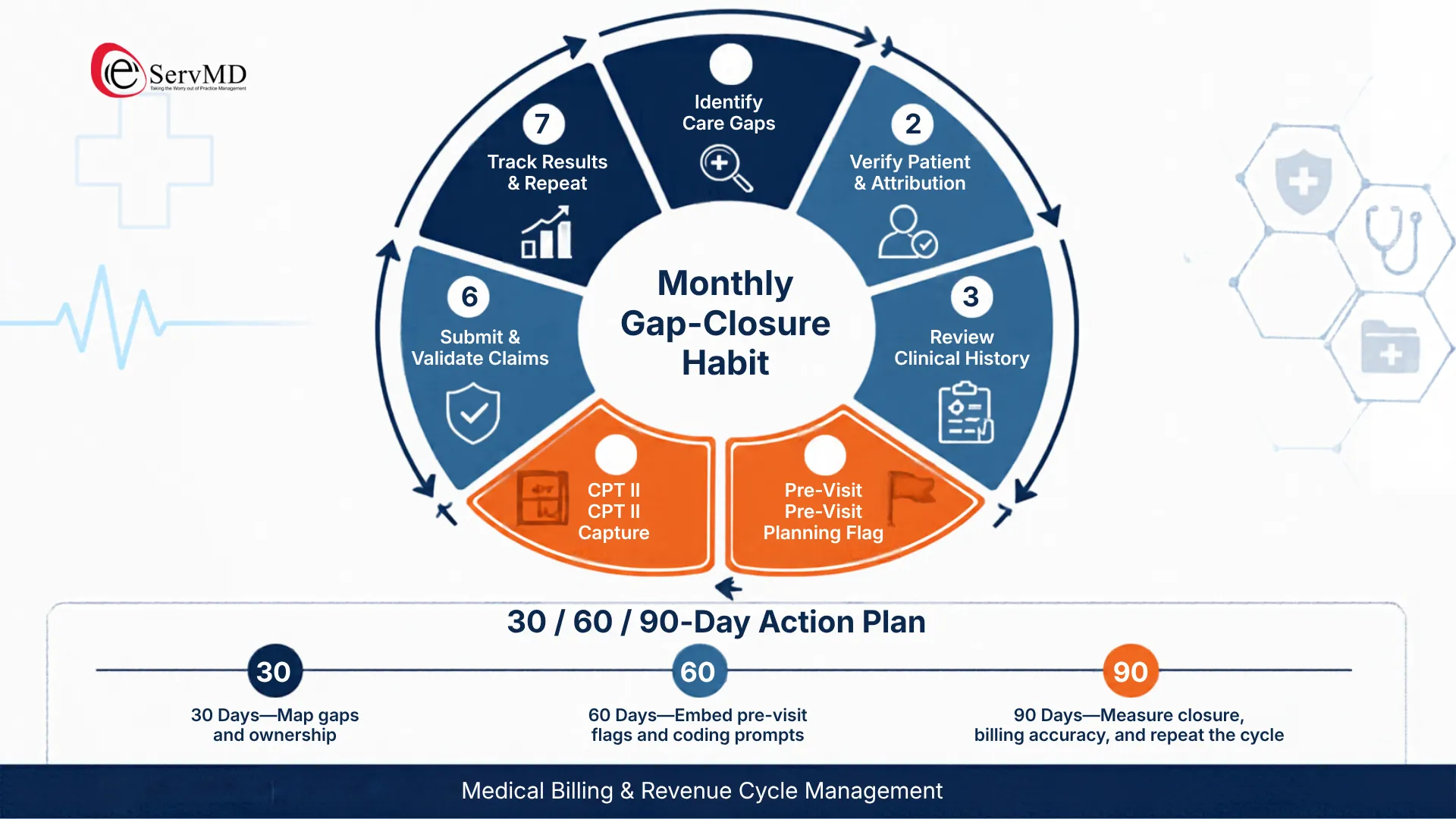
A gap in care is a patient who qualifies for a measure but has no record of the required service. Gap in care closure means getting the service done, documented, and reported to the plan before the measurement year ends. A repeatable monthly routine works better than a year-end scramble:
-
Download gap lists from each payer portal on a fixed date every month.
-
Reconcile the list with your EHR. Some gaps are false because the service happened elsewhere, the result sits in a scanned document, or the patient has an exclusion.
-
Rank gaps by measure value to you (contract exhibit, bonus tier, or Star weight) and by how easy they are to close.
-
Flag patients in pre-visit planning so the care team closes the gap during an existing appointment.
-
Capture the result and the right codes at the visit, including CPT II codes where the payer accepts them.
-
Send supplemental data for services done outside your office, such as outside lab results or screenings, using each payer's process.
-
Re-pull the list the next month to confirm the plan registered the closure.
Practices that lack the staff for this loop often bring in practice management consulting to assign owners and build the reporting calendar.
The NCQA HEDIS Audit: What It Means for a Practice
The NCQA HEDIS audit applies to health plans, not to individual practices. According to NCQA, all health plans submitting HEDIS data must undergo a HEDIS Compliance Audit, performed by licensed organizations using certified auditors. It is a two-part review: first the plan's information systems, then its compliance with the HEDIS specifications.
The audit reaches your office through documentation. If a plan reports that a patient was screened, the auditor expects the rate to trace back to source records. For your charts, that means the date, the result or finding, and the ordering or rendering provider must be readable and complete. A note that says "colonoscopy done" with no date may not count. A compliance and audit review of your documentation and coding can catch these weaknesses before a plan's chart request does.
Common Mistakes and Misconceptions
-
Assuming HEDIS is a practice submission program. It is plan-reported. Your job is to make the plan's data complete and accurate.
-
Mixing up MIPS and HEDIS. Different reporter, different scorer, different payment consequence.
-
Treating every measure as equal. Prioritize the measures named in your contracts and the high-volume measures in your panel.
-
Recording results only as free text. Results hidden in notes or scanned PDFs are the ones plans miss in claims-based review.
-
Ignoring exclusions. A patient who qualifies for an exclusion should be documented as one, not chased.
-
Trusting gap lists without checking them. Lists lag, and services done elsewhere may not appear.
-
Starting in the fourth quarter. Scheduling capacity runs out and the clock runs with it.
-
Forgetting attribution. Rates follow the provider or group the plan assigns, so check enrollment and NPI data.
Actionable Recommendations
|
Timeframe |
Action |
Suggested owner |
|---|---|---|
|
Next 30 days |
Collect the quality exhibit from each payer contract and list the measures, thresholds, and payment timing. Pull the current gap list from each portal. |
Practice manager |
|
Days 30 to 60 |
Build a one-page scorecard: measure, eligible patients, current rate, target, payer, value. Audit CPT II and diagnosis coding on a sample of recent diabetic and hypertensive visits. |
Billing lead and coder |
|
Days 60 to 90 |
Add gap flags to pre-visit planning. Set up supplemental data submission with each payer. Schedule a monthly review. |
Clinical lead and front desk |
|
Ongoing |
Reconcile payer gap lists monthly, track closure rate, and review claim rejections that affect quality data. |
Billing and care team |
Conclusion: Turn HEDIS Reporting Into a Revenue Habit
HEDIS shows up on your payer scorecards whether or not anyone in the practice owns it. Treat the measures in your contracts as scheduled work: know the targets, check the data, close gaps during regular visits, and keep documentation and codes clean. That approach protects incentive income and the billable care behind it.
eServMD supports practices with revenue cycle management that covers coding accuracy, claim quality, and payer follow-up. If you want help reading your payer quality exhibits or tightening the billing side of HEDIS reporting, schedule a free demo and bring your latest payer scorecard.
This article is educational and does not replace payer contract review or compliance advice. HEDIS specifications, Star Ratings measures, and MIPS requirements are updated regularly, so confirm current details with NCQA, CMS, and your payers.
Frequently Asked Questions About HEDIS
What does HEDIS stand for?
HEDIS stands for Healthcare Effectiveness Data and Information Set. NCQA develops and maintains it, and health plans use it to report performance on preventive care, chronic condition management, behavioral health, and related areas.
Do medical practices report HEDIS measures?
No. Health plans report HEDIS. Practices supply the underlying information through claims, supplemental data, and medical record requests, which is why practice documentation and billing accuracy affect plan results.
Is HEDIS the same as MIPS?
No. Clinicians report MIPS measures directly to CMS for Medicare Part B payment adjustments. HEDIS is reported by health plans. Some clinical topics overlap, but the reporting channels and payment consequences are separate.
How do HEDIS measures relate to Medicare Star Ratings?
CMS uses HEDIS data as one input to Medicare Advantage Star Ratings, alongside CAHPS, Health Outcomes Survey, and administrative data. Plans respond to weak HEDIS results with outreach, gap lists, and chart requests to practices.
What is gap in care closure?
It is the process of identifying patients who qualify for a measure but lack the required service, getting the service done, and ensuring the plan receives documentation of it before the measurement year ends.
Does the NCQA HEDIS audit apply to my practice?
The audit applies to health plans. Your practice is affected indirectly because audited rates must trace back to source records, so incomplete or unclear charts can be rejected during validation.
How do HEDIS results connect to practice income?
Through payer-specific quality incentives, value-based contract terms, plan outreach programs, and the billable visits and services that close care gaps. There is no single national payment figure. Review each contract to see what applies to you.
Can a billing company help with HEDIS?
A billing partner can help with the parts that sit in the revenue cycle: coding accuracy, CPT II capture, clean claim submission, provider attribution, and denial follow-up. Clinical care and chart documentation remain with the practice.