On this page
Inpatient vs outpatient billing comes down to one question: was the patient formally admitted to the hospital? The answer changes the claim form, the code sets, how the hospital is paid, and, for physicians, the place of service code. A wrong answer turns a correct visit into a denied claim.
This guide explains the differences for medical practices, hospitals, urgent care centers, labs, and new practices. It relies on CMS, HHS, and CDC sources, and it flags where payers differ.
Inpatient vs. Outpatient the key difference in one view
an inpatient is formally admitted to a hospital on a practitioner's order. An outpatient is not, even if the patient stays overnight. Hospitals bill both on the UB-04 (837I), but inpatient stays are generally paid per stay and outpatient services are paid by service. Physicians bill both on the CMS-1500 (837P), reporting POS 21 for inpatients and POS 19 or 22 for hospital outpatients.
What counts as inpatient vs outpatient?
The admission order decides, not the clock or the bed
Under Original Medicare, Part A covers inpatient hospital services, while Part B covers outpatient hospital services and doctor services. Inpatient status begins with a formal admission order. 42 CFR § 412.3 sets the rules for that order for Part A payment.
A patient can spend a night in a hospital bed and still be an outpatient. The status follows the order, not the room.
Observation status is outpatient
Observation helps clinicians decide whether to admit a patient or send them home. Medicare treats patients receiving observation services as outpatients. That means Part B rules, outpatient facility billing, and, on professional claims, an outpatient POS. CMS manual guidance says the admit-or-discharge decision can usually be made in under 24 hours, and in most cases within 48 (Medicare Benefit Policy Manual, Chapter 6, section 20.6).
For Medicare patients, hospitals also give a Medicare Outpatient Observation Notice (MOON) when observation runs past 24 hours. Observation status billing is one of the most common sources of status disputes, so it deserves its own check.
The two-midnight benchmark, in plain terms
For Medicare Part A, an inpatient admission is generally appropriate when the admitting practitioner expects the patient to need hospital care that crosses two midnights. CMS codified this in 42 CFR 412.3, effective October 1, 2013. Two exceptions matter:
-
Procedures on Medicare's inpatient-only list are generally appropriate for inpatient admission regardless of expected stay.
-
Shorter stays can qualify case by case when the record clearly supports the clinical judgment.
Two cautions. First, time before the order still counts toward the expectation, but it is outpatient time. Second, an inpatient order must exist at or before admission. Without it, the hospital cannot bill an inpatient claim.
Facility billing vs professional billing: two claims for one encounter
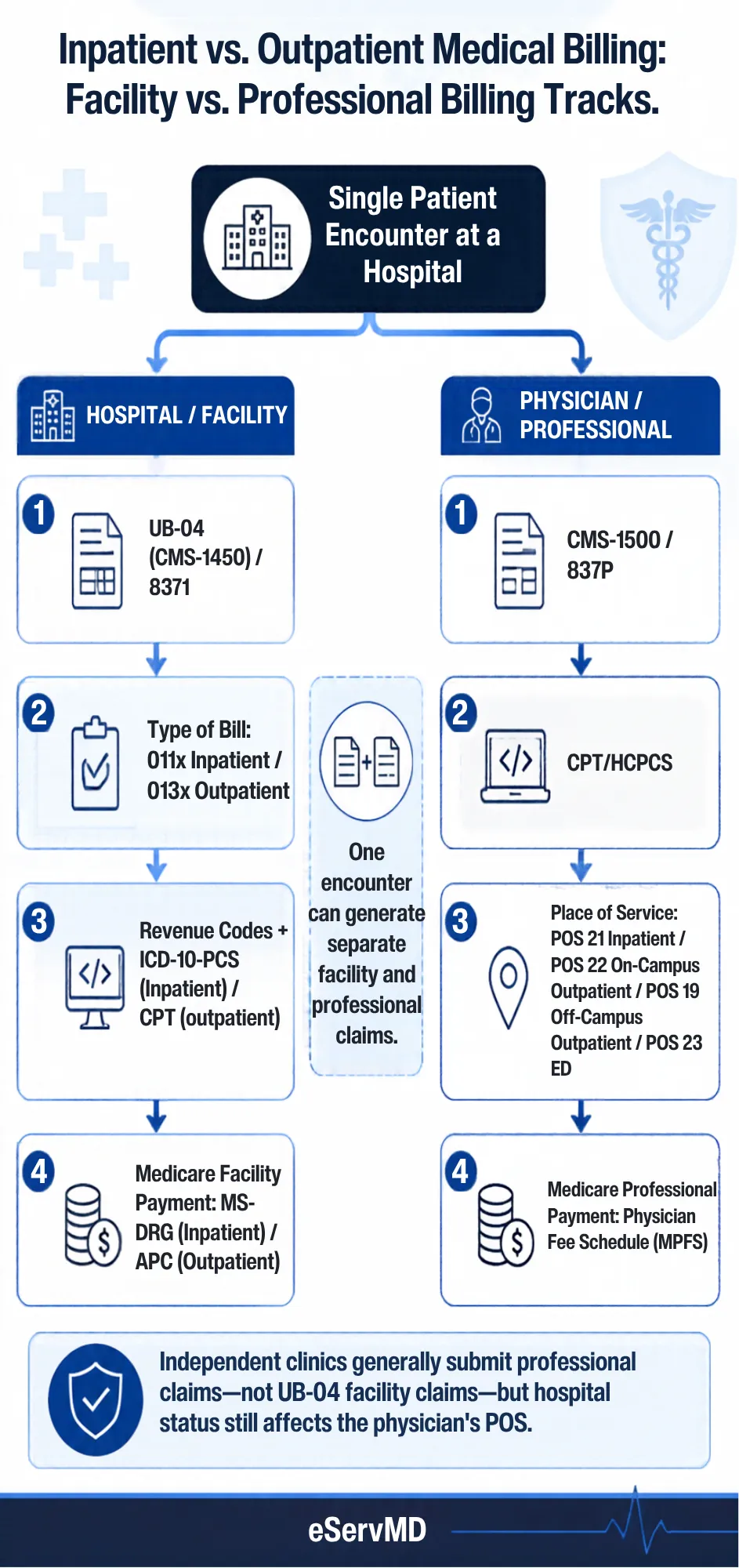
The first thing to separate in inpatient vs outpatient medical billing is who is billing. The hospital bills for the facility. Each physician or practitioner bills for their own work. These are different claims with different forms.
UB-04 (CMS-1450) and the 837I
The UB-04, also called CMS-1450, is the institutional claim form. The National Uniform Billing Committee (NUBC) maintains it and its code sets. It has 81 form locators and an electronic version, the 837I. It carries items a professional claim does not, such as type of bill, revenue codes, and admission and discharge data.
CMS-1500 and the 837P
The CMS-1500 and its electronic version, the 837P, carry professional claims. When a physician treats a patient inside a hospital, the physician's services stay on the CMS-1500 while the hospital bills its own charges on the UB-04.
In practice: if you run an independent clinic or group, you generally do not submit a UB-04. You still feel hospital status, because your POS must match it. Confirm any exception with the payer.
Inpatient vs outpatient medical billing at a glance
|
Factor |
Inpatient |
Outpatient |
|---|---|---|
|
Definition |
Formally admitted on a practitioner's order |
Not admitted; includes ED visits, observation, same-day surgery, and clinic visits |
|
Original Medicare coverage |
Part A for the hospital stay; Part B for doctor services |
Part B |
|
Facility claim |
UB-04 / 837I, type of bill in the 011x family |
UB-04 / 837I, type of bill in the 013x family |
|
Professional claim |
CMS-1500 / 837P with POS 21 |
CMS-1500 / 837P with POS 22 or 19 (POS 23 for the ED) |
|
Facility diagnosis and procedure codes |
ICD-10-CM plus ICD-10-PCS |
ICD-10-CM plus CPT/HCPCS |
|
Uncertain diagnoses |
May be coded as established at discharge (Section II.H) |
Not coded; report signs and symptoms (Section IV.H) |
|
Medicare facility payment |
One payment per stay, set by MS-DRG |
Payment by service under outpatient payment rules |
|
Common denial triggers |
Admission order or medical necessity gaps; status mismatch |
Wrong POS; observation vs inpatient confusion; missing modifiers |
The type-of-bill families above are the standard NUBC groupings for hospital inpatient and outpatient claims; confirm exact bill types with the NUBC manual or your payer.
How the coding differs
Code sets and uncertain diagnoses
Both settings use ICD-10-CM for diagnoses. Hospital inpatient claims add ICD-10-PCS for procedures. Outpatient claims, and every professional claim, report procedures with CPT or HCPCS. Same-day surgery coding is a good example: the hospital outpatient claim lists CPT codes for the procedure, and the surgeon's CMS-1500 lists CPT codes for the surgeon's work.
The ICD-10-CM Official Guidelines also treat uncertainty differently. For inpatient discharge diagnoses, Section II.H lets coders report conditions documented as "probable" or "suspected" as if established. For outpatient services, Section IV.H says not to. The same wording in a note can be reportable in one setting and not in the other.
Revenue codes vs CPT codes
Revenue codes are four-digit facility codes that tell the payer which hospital department or service category generated a charge. CPT and HCPCS codes say what was performed. A hospital claim usually needs both, and they do not substitute for each other. Revenue code 0111, for example, is a room-and-board code, which only exists on the facility side. Professional claims do not use revenue codes.
Inpatient and observation E/M codes since 2023
Physician coding changed in a way many older articles miss. Effective January 1, 2023, the separate observation E/M codes 99217 to 99220 were deleted, and initial and subsequent hospital care codes 99221 to 99239 cover both inpatient and observation. That means CPT 99223 can appear on either type of claim. The POS is what tells the payer whether the patient was an inpatient or an outpatient.
How payment differs
Inpatient: MS-DRG under IPPS
Under Medicare's inpatient prospective payment system, the Medicare contractor assigns each case to an MS-DRG based on diagnoses, procedures, age, sex, and discharge status. CMS maintains hundreds of MS-DRGs and updates them every fiscal year. Documentation therefore directly drives payment: a missed secondary condition can change the group.
Outpatient: payment by service
Hospital outpatient services under Medicare are paid by service under the outpatient prospective payment system, using ambulatory payment classifications. CMS describes both systems in its payment systems overview. Professionals are paid under the Medicare Physician Fee Schedule. Commercial payers use their own contracts, such as case rates, per diems, or fee schedules, so check each agreement.
POS 21 vs POS 22 billing (and POS 19)
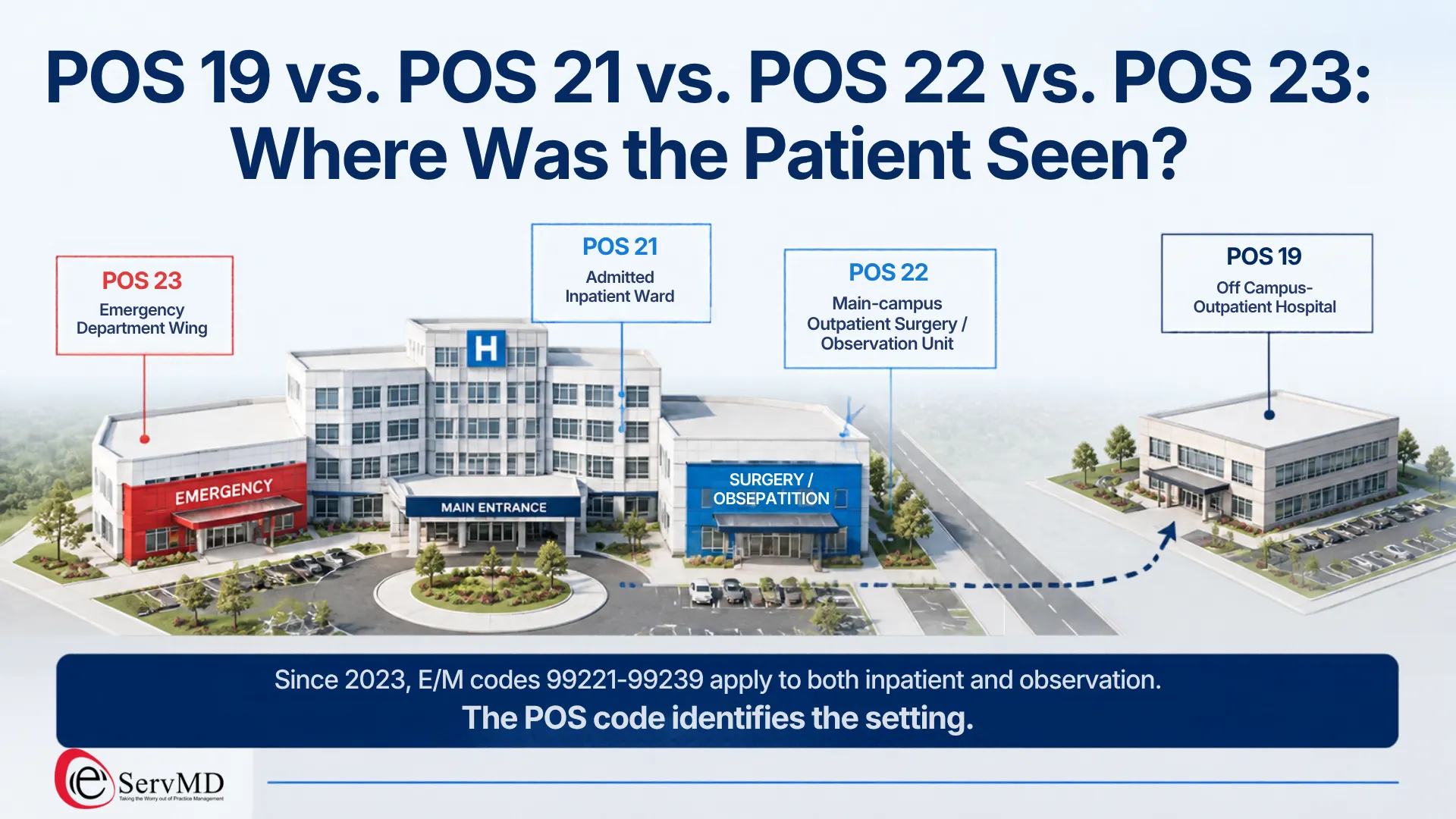
The place of service code on the CMS-1500 follows the patient's status on the date of service. It does not follow where the physician stands. CMS says physician services to hospital inpatients and registered outpatients are paid at the facility rate when POS 19, 21, or 22 is reported.
|
POS |
CMS name |
Use it when |
Common mistake |
|---|---|---|---|
|
21 |
Inpatient Hospital |
The patient is formally admitted as an inpatient |
Using it for observation patients |
|
22 |
On Campus-Outpatient Hospital |
The patient is a registered outpatient on the hospital's main campus, including observation and outpatient surgery |
Using it for an off-campus department |
|
19 |
Off Campus-Outpatient Hospital |
The patient is a registered outpatient of an off-campus provider-based department |
Confusing it with POS 22 or POS 11 |
|
23 |
Emergency Room - Hospital |
ED services |
Keeping POS 23 on later inpatient or observation visits |
Definitions come from the CMS place of service code set. CMS added POS 19 and renamed POS 22 "On Campus-Outpatient Hospital" effective January 1, 2016, and contractors treat the two the same way. For a deeper comparison, read our posts on POS 21 vs. POS 22, POS 21 (inpatient hospital), and POS 22 (on-campus outpatient hospital).
A worked scenario: one patient, three statuses
This example is illustrative, not a real case.
-
Monday, 9 p.m.: A Medicare patient arrives at the ED with chest pain. The ED physician bills an ED visit with POS 23. The hospital's claim is outpatient so far.
-
Tuesday morning: The patient is placed in observation. A cardiologist's visit is billed with POS 22. Observation is outpatient.
-
Tuesday, 3 p.m.: The cardiologist now expects the patient to need hospital care past the second midnight and writes an inpatient admission order. From this point the patient is an inpatient.
-
Wednesday: The cardiologist's visit is billed with POS 21. The E/M code family may be the same as Tuesday's; the POS changes.
-
Thursday: Discharge. The hospital bills the stay on an inpatient UB-04. Under Medicare's payment window, related outpatient services at the same hospital shortly before admission are generally folded into that inpatient claim.
If the order is missing or late, the facility claim may be denied or billed as outpatient while your POS 21 professional claims stay as submitted. That mismatch is a classic source of denials.
Common mistakes that trigger denials
-
Treating an overnight stay as inpatient. Status follows the order, and observation is outpatient.
-
Reporting POS 21 for observation. Use the outpatient hospital POS instead.
-
Mixing up POS 19 and POS 22. One is off campus, the other is on campus. Both generally carry the facility rate.
-
Billing before confirming status. Status can change mid-stay, and your POS must follow it.
-
Applying one set of diagnosis rules to both settings. Uncertain-diagnosis rules differ.
-
Treating revenue codes and CPT codes as interchangeable. Facility claims need both.
-
Assuming Medicare rules apply to every payer. See the next section.
Denials from any of these are easier to fix when you know the reason code and root cause. Our guide to denial management walks through that process.
Expert considerations
Payers do not all follow Medicare
The two-midnight benchmark governs Medicare Part A payment. Medicare Advantage is the area where older articles conflict. CMS has since said Medicare Advantage plans must follow the benchmark, though you should still confirm plan-specific rules. Commercial payers and Medicaid set their own admission criteria, authorization requirements, and POS edits. Start with your payer manuals and, for Medicare POS questions, our Medicare place of service codes guide.
Who owns the status decision
The hospital and the admitting practitioner decide status. A clinic's billing team does not, but it must verify status before billing. Typical safeguards include checking admission notifications from the hospital, reviewing the hospital record for the order date and time, and training staff on the observation vs inpatient distinction. If a hospital changes status during the stay, your later services need the POS that matches the new status.
Pre-submission checklist
-
Confirm the patient's status and the admission order date and time for each service date.
-
Match POS to that status (21, 22, 19, or 23).
-
Confirm the claim type: 837P for professional services, 837I for facility services.
-
For facility claims, verify type of bill, revenue codes, and the right procedure code set.
-
Apply the diagnosis reporting rules for the setting.
-
Check payer rules for notification or authorization of admissions.
-
Track denials by cause, especially status and POS, and fix the source.
This article is general information, not legal, coding, or compliance advice. Rules change, so verify against current CMS and payer guidance.
Conclusion
Inpatient vs outpatient medical billing is not a paperwork distinction. It sets the claim form, the code sets, the payment method, and the POS you report. The most useful habit is simple: confirm status first, then build the claim around it.
If status mismatches or POS denials keep recurring, e ServM's hospital billing services can help review the workflow. You can also schedule a demo to talk through your claims.
Frequently asked questions
What is the main difference between inpatient and outpatient billing?
Inpatient billing covers patients formally admitted to a hospital on a practitioner's order. Outpatient billing covers everyone else, including ED, observation, and same-day surgery patients. The status changes the facility's payment method, the code sets used, and the POS on professional claims.
Is observation status inpatient or outpatient?
Outpatient. Medicare treats patients getting observation services as outpatients, so Part B rules apply. On a professional claim, use an outpatient hospital POS, not POS 21.
What is the difference between POS 21 and POS 22?
POS 21 is Inpatient Hospital and POS 22 is On Campus-Outpatient Hospital, per the CMS place of service code set. POS 19 covers off-campus outpatient hospital departments. See our POS 21 vs. POS 22 comparison for examples.
What claim form does each type of billing use?
Hospitals use the UB-04 (CMS-1450), or the 837I electronically, for inpatient and outpatient facility claims. Physicians and other professionals use the CMS-1500, or the 837P electronically, in both settings.
Does a patient who stays overnight count as an inpatient?
No. Inpatient status needs a formal admission order. A patient can stay overnight in observation or the ED and remain an outpatient.